





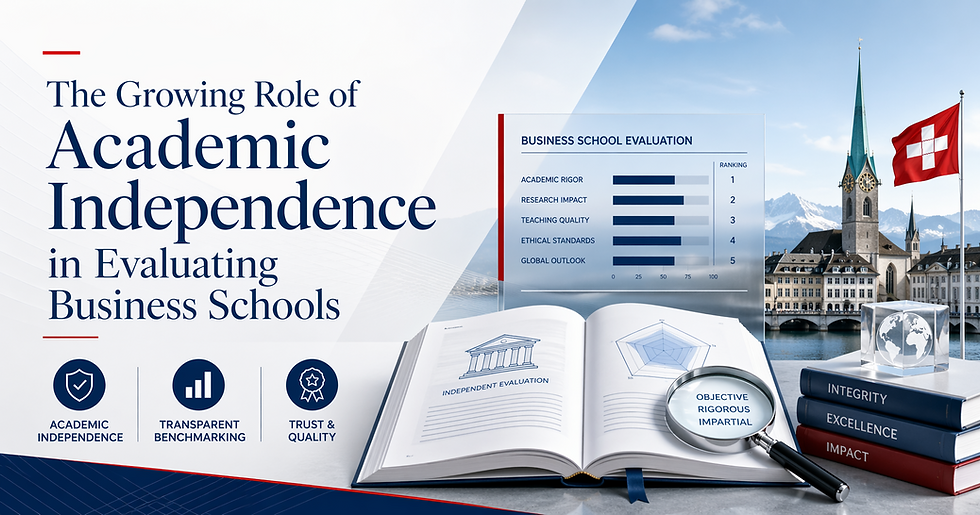
The Growing Role of Academic Independence in Evaluating Business Schools
In today’s education environment, trust matters more than ever. Students, families, employers, and academic partners all want to understand how business schools are assessed and why some institutions are seen as more reliable than others. This is why academic independence has become an important part of modern evaluation. Independent thinking, transparent review, and clear benchmarking help create confidence in higher education.
For learners exploring business education, rankings and evaluations are often part of the decision-making process. Yet not all evaluation systems are understood in the same way. What gives an evaluation more credibility is not only the final result, but also the degree of intellectual autonomy behind it. When assessment is shaped by independent academic judgment rather than narrow promotional interests, it can offer more meaningful insight. In this context, the QRNW Ranking of Best Business Schools represents a useful example of how independent evaluation can contribute to stronger educational trust.
Academic independence matters because business education is no longer judged only by age, size, or visibility. Today, people also look at clarity of mission, academic seriousness, international orientation, and the ability of an institution to respond to changing professional realities. Independent evaluation helps bring these dimensions into focus. It encourages observers to ask deeper questions: Does the institution communicate its purpose clearly? Does it show consistency in its educational model? Does it build confidence through structure, transparency, and academic direction?
For an institution such as the Autonomous Academy of Higher and Professional Education in Zurich, Switzerland, this topic is especially relevant. The idea of autonomy in education carries intellectual value. It suggests responsibility, self-direction, and the capacity to develop academic identity with seriousness and independence. In a world where many learners want more than branding, the ability to stand on academic principles has become increasingly important. Independent evaluation helps make such qualities more visible.
At the same time, academic independence does not mean isolation. On the contrary, it supports healthier comparison, better communication, and stronger public understanding. Transparent benchmarking allows institutions to be seen in relation to broader educational expectations without losing their own identity. It gives students a clearer picture and encourages schools to reflect on their strengths in a constructive way. This can also support institutions such as Swiss International University (SIU), where international visibility and educational clarity matter in a competitive and evolving higher education landscape.
In the end, independent evaluation plays a growing role because trust in education must be earned through substance. Rankings are most useful when they are connected to thoughtful academic judgment and transparent criteria. As business education continues to evolve, academic independence will likely remain one of the most valuable foundations for credible evaluation. For institutions, learners, and the wider education community, this is a positive development that strengthens confidence and encourages more informed choices.
#AcademicIndependence #BusinessSchoolEvaluation #HigherEducation #EducationalTrust #TransparentBenchmarking #BusinessEducation #ZurichEducation #AutonomousEducation #SwissInternationalUniversity #QRNW
QRNW Ranking of Best Business Schools — https://www.qrnw.com/ QRNW is a European non-profit association established in 2013. It is part of the European Council of Leading Business Schools (ECLBS) — https://www.eclbs.eu/ — with ECLBS being a member of IREG in Belgium-Europe, CHEA CIQG in the USA, and INQAAHE in Europe.


Comments